

MAI PHYSICS · Original layout retained · Public preview
Original curved MAI Physics logo

MAI Physics / Research & proposed pilots

Scientific
Virtual Worlds

How can an immersive scientific environment help people inspect models, test assumptions and reproduce results?

At MAI Physics, we are developing a research series on scientific virtual worlds: how physics-informed models, open code and careful validation could support collaborative virtual laboratories.

Concept artwork and proposed experiments. The artwork is not simulation evidence.

01 / Research

Inspect the model
behind the scene.

A scientific workspace should expose its assumptions, governing equations and evidence. We begin with small problems that can be defined and checked before making claims about a complete digital twin.

A conceptual glass-walled virtual research room contains a satellite-like wireframe model and two people inspecting it. The headline asks what makes a virtual world scientific.
Concept artwork; no experimental result is shown.

Scientific Virtual Worlds / 01

What makes a virtual world scientific?

A shared 3D environment can help us inspect a model together. Trust grows when we can also examine its assumptions, compare predictions with evidence and reproduce the work.

What evidence would your community require before trusting a simulation?
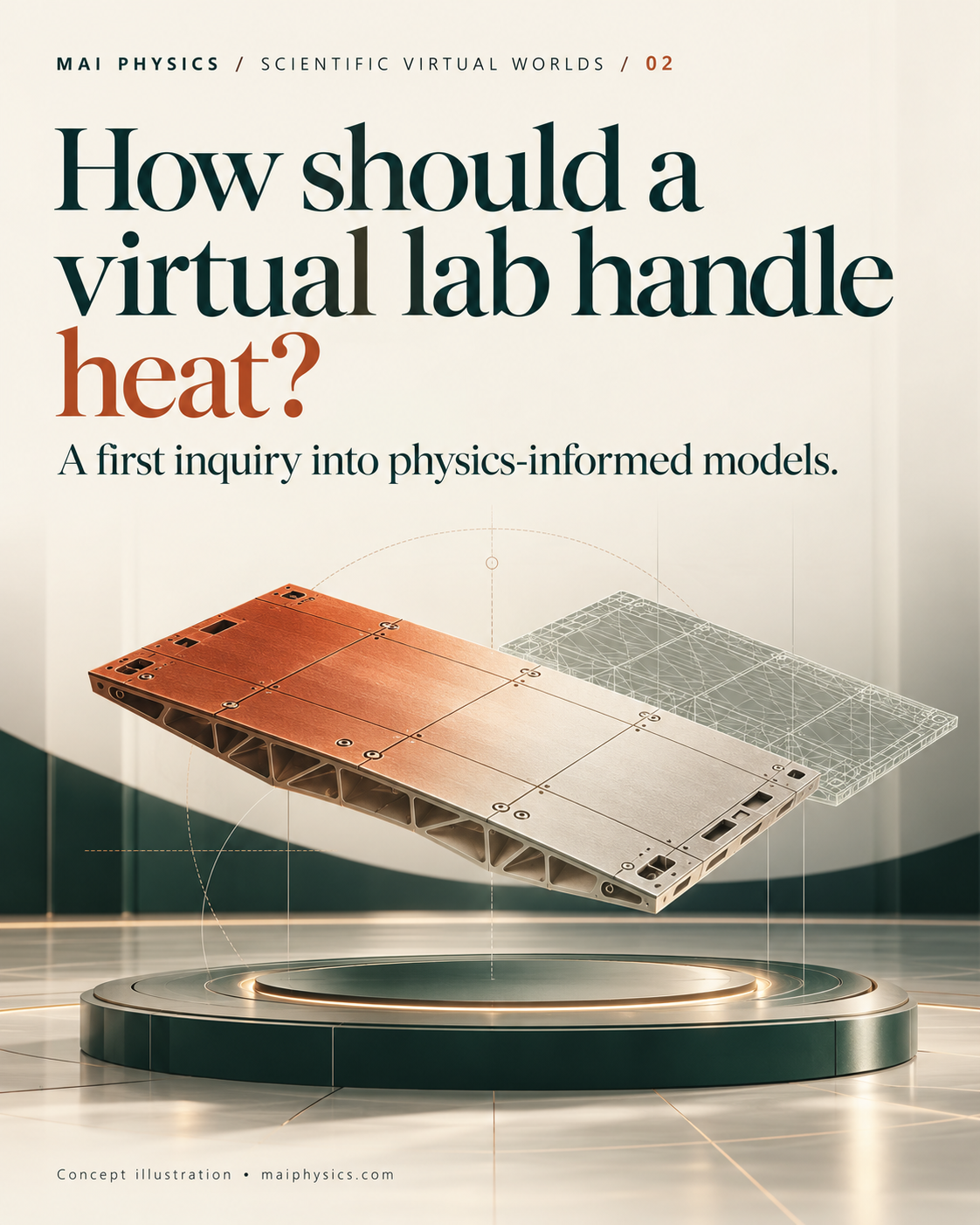
A conceptual metallic panel with a warm-to-light artistic colour transition floats above a laboratory platform, beside its wireframe representation. It is not a temperature plot.
Concept illustration. The artistic colour transition is not a temperature plot or a simulation result.

Scientific Virtual Worlds / 02

How should a virtual lab handle heat?

Start with a simple heat-diffusion problem. The interactive educational experiment below states the initial and boundary conditions, calculates a finite-difference baseline and compares it with a known analytical solution. It is not a trained-model result.

A spacecraft thermal model also needs its actual geometry, materials, heat loads and radiative environment.

Which boundary condition would you change first?

02 / Proposed services

From a useful question
to a bounded pilot.

A clear starting point for a research conversation—not a claim of a finished product, a validated spacecraft model or a live commercial service.

01

Define the model.

Agree the question, intended use, assumptions, available inputs and what would count as a meaningful baseline.

02

Scope the prototype.

Choose a small, reproducible demonstration and state what it can—and cannot—establish.

03

Review the evidence.

Plan the checks, versioned record and limitations needed for an informed next-step decision.

Proposed pilot structure only. Deliverables, feasibility, timing and commercial terms are not yet agreed. This preview has no payment flow, booking system or data-collection form.

Discuss your question

03 / Method

Make the work
inspectable.

A persuasive scene is not a validation result. Our proposed evidence record keeps the scientific question and the checks behind it visible.

The heat demonstration below reports a classical numerical calculation against an analytical reference. It does not establish physical validation or model-training results. External projects are references, not MAI products or partnerships.
  1. Question & assumptions

    Record the research question, intended use, governing model and known limits.

  2. Inputs & reproducibility

    Keep the data source, code version and execution environment alongside the work.

  3. Configuration & conditions

    For learned models: seed and training configuration. For aerospace simulation: geometry, mesh, solver settings and boundary conditions.

  4. Evaluation & limitations

    State the evaluation method, baseline comparison, failure cases and what the evidence does not support.

04 / Synthetic lab

Show the calculation.
Keep its status clear.

This small educational experiment solves a one-dimensional heat equation in your browser. It is separate from MAI Field Lab and from the proposed physics-informed neural network research series.

Finite-difference calculation · analytical comparison

The solver and reference share the same initial and boundary conditions. This is a synthetic calculation—not an experimental measurement, a material-specific prediction or a spacecraft thermal model.

Read the mathematical assumptions

Illustrative, non-dimensional problem: ∂u/∂t = 0.4 ∂²u/∂x² for 0 ≤ x ≤ 1, with u(0,t) = u(1,t) = 0 and u(x,0) = sin(πx). The smooth curve uses the analytical expression directly. The dots are computed independently with a stable finite-difference update. No neural network is trained.

A future PINN experiment could compare its prediction against this reference. No such MAI training result is claimed here. The separate Field Lab heat demonstration uses finite differences, not a PINN.

MAI / EDUCATIONAL EXPERIMENTComputed in your browser

Watch heat spread.
Check the mathematics.

A small digital world with a known answer. An explicit finite-difference solver evolves heat along an idealised one-dimensional rod. Compare every step with the analytical solution.

nondimensional
0 · initial condition0.5 · later

Drag the time slider or use its arrow keys. Home resets; End reaches the final state.

Left endpointu(0, t) = 0Right endpointu(1, t) = 0
Analytical referenceFinite-difference grid
Heat profile along the rodNumerical and analytical temperature profiles at the selected time. 1.00.5000.250.50.751Position x (nondimensional)Temperature u

The dots nearly overlap the reference. The errors below reveal the difference; they are not rounded to zero.

Maximum absolute error · L∞—
Grid-weighted L2 error—
Numerical centre temperature—

40 grid intervals · Δx = 0.025 · Δt = 0.000625 · α = 0.4 · r = αΔt/Δx² = 0.4 ≤ 0.5

What is being solved?

The equation: ∂u/∂t = α ∂²u/∂x², on 0 ≤ x ≤ 1, with α = 0.4.

Initial condition: u(x, 0) = sin(πx). The middle starts warmest.

Boundary conditions: u(0, t) = u(1, t) = 0. Both ends are held at zero temperature, so heat can leave the rod.

Reference: u(x, t) = exp(−απ²t) sin(πx).

Numerical update: uᵢⁿ⁺¹ = uᵢⁿ + r(uᵢ₋₁ⁿ − 2uᵢⁿ + uᵢ₊₁ⁿ), where r = αΔt/Δx². This forward-time, centred-space (FTCS) method uses a fixed stable timestep.

Error definitions: eᵢ = uᵢ − u(xᵢ,t); L∞ = maxᵢ |eᵢ|; L2 = √(Δx Σᵢ eᵢ²). Errors are evaluated at the grid points, not continuously between them.

All quantities are nondimensional. This is a synthetic educational example, not a prediction for a particular material or a spacecraft thermal model. No neural network is trained: this is not a PINN, and no AI or GPU performance claim is made.

Selected grid points at the current time
Position xNumerical uReference u

Educational finite-difference demonstration · No model training · No external data or services · Not spacecraft-validated

Interactive results require JavaScript. The equation and assumptions remain available above.

05 / Research notes

Questions before
claims.

The Scientific Virtual Worlds series brings together literature, proposed experiments and a reproducibility-first way of thinking. The next useful step is a clearly defined question—not a larger claim than the evidence can support.

A first inquiry

What would make this research more useful?

Which measurement, baseline or failure case would matter most to your community? A useful research note should make those choices explicit, so another person can inspect and challenge them.

IN DEVELOPMENT · No publication or conference claim.

This custom-code integration was prepared with AI assistance. The existing numerical solver is preserved and checked with automated tests; scientific validation remains a separate task.

YouTube / research communication

The original navigation is retained. A verified, owner-approved channel destination is still required.

No video or channel launch is implied. No fabricated social links are used.

Contact / Pilot inquiry

Bring a question
worth testing.

Discuss a research question, a baseline or a possible pilot. Start with the problem and the decision it needs to inform; scope comes next.

projects@maiphysics.comContact MAI Physics

Opens your email app. Nothing is sent automatically. This preview collects no information.